AI SEO is the future of how customers find your business online, and that future is already here. As search evolves with innovations like Google's AI Overviews and conversational tools such as ChatGPT, a wave of new and often confusing terminology has emerged.
This simple guide for 2025 is designed to give you clarity. We will explain every essential AI SEO term, from GEO to AEO to LLMO, and show you how to build a practical strategy for growth.
At SEOCoaching.com, our goal is to empower you with the knowledge to lead your own marketing. With this guide, you will gain the confidence to succeed in the new era of search.
Why Your Business Needs an AI SEO Strategy
The way people look for information has fundamentally changed. Users are moving from typing short keywords to asking full questions in conversational AI tools. In fact, marketers say the SEO model is shifting "from a click-based economy to a citation-based economy." This means it is no longer just about getting a click from Google, but about having AI cite your business as the answer. Your old SEO playbook needs an update for this new reality.
This new landscape is a massive opportunity. As more users turn to AI for answers, businesses that adapt will gain a significant competitive edge. Adapting means being present wherever your ideal customers are asking questions, whether that is in Google's AI results, voice assistants, or even social media search. Your goal is to become the definitive answer to those questions. By optimizing for this new reality, you future-proof your business and build a sustainable path for customers to find you.
A Glossary of AI SEO Terms: From GEO to LLMO
Navigating AI-powered search means learning a new vocabulary. Below, we break down the most important terms into simple, scannable definitions. These acronyms might sound technical, but each has a practical implication for your marketing. It is more important to understand the core principle than to obsess over the specific acronym.
AI SEO (Artificial Intelligence SEO)
What It Is
AI SEO is the broad term for optimizing your website to rank well in AI-driven search results, like AI overviews on Google or answers from chatbots. In other words, it is about making your content easily understood, trusted, and cited by artificial intelligence.
What It Focuses On
It focuses on ensuring your site's content is clear and authoritative so that AI systems will feature it in responses. AI SEO builds on traditional signals like quality content and credibility but prioritizes directly answering questions over just matching keywords.
How It Differs from Traditional SEO
Traditional SEO is about improving your rank among a list of blue links. AI SEO, by contrast, is about becoming the answer an AI provides. It still values factors like E-E-A-T (Experience, Expertise, Authoritativeness, Trustworthiness), but it also considers if your content can be easily summarized or quoted by an AI tool.
Example for Entrepreneurs
A local bakery implements AI SEO best practices. When a user asks ChatGPT for "the best gluten-free cakes nearby," the bakery's name and offerings are mentioned in the AI's answer. By optimizing its content and having strong customer reviews, the bakery becomes the recommended answer.
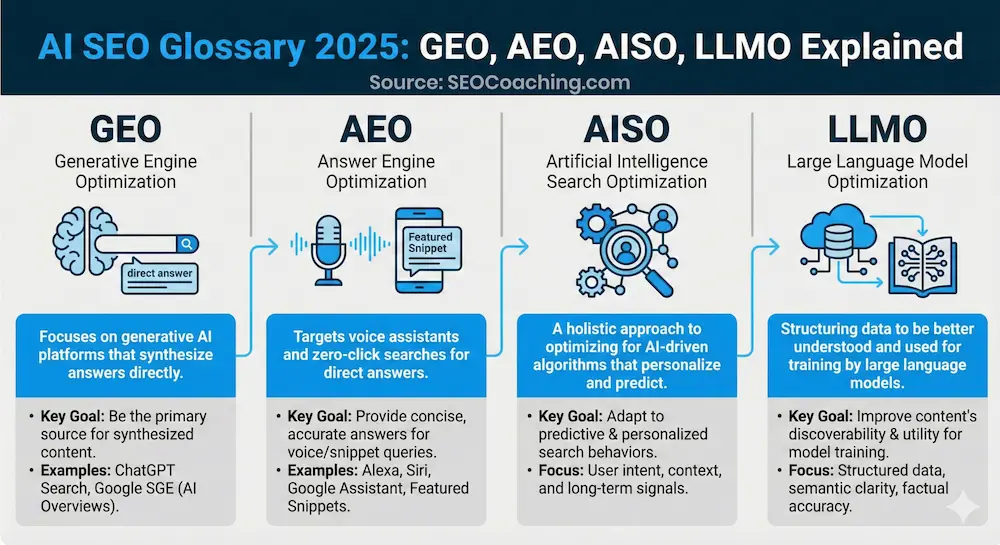
GEO (Generative Engine Optimization)
What It Is
Generative Engine Optimization (GEO) is the practice of optimizing your content to be featured as a cited source in generative AI results. For example, it helps you appear in Google's AI-generated search summaries at the top of the page. It is all about earning that reference or citation from the AI.
What It Focuses On
GEO focuses specifically on appearing in AI-generated answers. It is less about your overall site ranking and more about becoming the trusted source that an AI quotes in its response. This means providing well-structured, context-rich content that an AI can easily use.
How It Differs from Traditional SEO
Instead of optimizing just to rank #1, GEO is about being the source. In a traditional search, a high rank might get you a click. In the AI world, a high-quality piece of content might get your information included directly in the answer, sometimes without a click. GEO requires you to focus on facts, data, and clarity so the AI chooses your content to cite.
Example for Entrepreneurs
A financial advisor writes a detailed article explaining Roth IRAs. Using GEO tactics, they structure the article with clear headings and trustworthy stats. The goal is that Google's AI Overview will use its article as a cited source when summarizing "What is a Roth IRA?". This puts the advisor's name in front of users without them having to click a link.
AEO (Answer Engine Optimization)
What It Is
Answer Engine Optimization (AEO) is a strategy focused on making your website provide the most direct and authoritative answer to customer questions. Think of it as aiming to be the equivalent of Google's featured snippet, but in an AI chat or voice assistant context.
What It Focuses On
AEO focuses on providing clear, concise, factual information that positions your content as the definitive answer. This often means formatting content in a Q&A style or adding FAQ sections so an AI can easily pull a straight answer. The emphasis is on clarity and correctness. If your answer is better than others, the AI will likely use yours.
How It Differs from Traditional SEO
Traditional SEO might target a keyword like "running shoes flat feet" and bury the answer in a long blog post. AEO would focus on directly answering "What are the best running shoes for flat feet?" in a concise paragraph. It is about answering questions, not just ranking for them.
Example for Entrepreneurs
A skincare brand creates a blog post that answers, in plain language, "What is the correct order to apply skincare products?" They list the steps clearly. With AEO in mind, they aim for an AI tool like Alexa to pull their step-by-step routine verbatim when someone asks the question.
AISO (AI Search Optimization)
What It Is
AI Search Optimization (AISO) is the practice of ensuring your business is visible across all platforms where users search with AI. This includes not just Google, but also TikTok search, YouTube, voice assistants, and dedicated Q&A bots. It is a holistic term recognizing that “search” now happens in many places.
What It Focuses On
AISO focuses on meeting your audience wherever they are searching. This involves a multi-platform content strategy. You must adapt your SEO approach to each channel, such as text content for web search, short video for social, and a conversational tone for voice.
How It Differs from Traditional SEO
Traditional SEO is heavily Google-centric, while AISO is platform-agnostic. It broadens optimization beyond your website's Google ranking. For instance, it might include optimizing video descriptions for YouTube or ensuring your business info is formatted so voice assistants can easily access it.
Example for Entrepreneurs
A travel blogger wants maximum reach. In addition to optimizing their blog for Google, they create quick TikTok videos answering questions like "How do I find cheap flights?" By doing so, the blogger's tips can surface on multiple AI-powered platforms.
LLMO (Large Language Model Optimization)
What It Is
Large Language Model Optimization (LLMO) is a technical approach to structuring your site's data so it can be easily crawled, understood, and used by large language models like ChatGPT. In essence, it is about making your content machine-friendly for AI systems.
What It Focuses On
LLMO focuses on highly technical elements that help AI understand your content accurately. This includes adding schema markup (structured data) to your HTML, maintaining a clear site architecture, and using unambiguous language.
How It Differs from Traditional SEO
Traditional technical SEO focuses on helping Google index your site. LLMO goes a step further to consider how an AI model ingests information. It emphasizes precision and structure over just keywords, ensuring an AI knows exactly what you mean.
Example for Entrepreneurs
A recipe website uses structured data (Recipe schema) to label ingredients, cooking times, and steps. Thanks to this LLMO practice, when a user asks an AI "How do I bake chocolate chip cookies?", the AI can quickly and accurately pull the ingredient list and steps from that site.
Less Common (But Good to Know) Terms
Beyond the main buzzwords, you might encounter these other terms. They are used less frequently, but it is useful to understand them:
- SEO for AI: A plain-English alternative to "AI SEO." It means the same thing but is framed as “SEO for AI platforms" instead of “AI-driven SEO.”
- AIO (AI Optimization): Another abbreviation for "AI SEO." In practice, AIO covers the same strategies, like making content machine-readable, trustworthy, and relevant for AI-driven answers.
- GAIO (Generative Artificial Intelligence Optimization): A more formal-sounding variant of GEO. It refers to optimizing for generative AI in general, not just search engines. Most people just say GEO or AI SEO instead of GAIO.
- LLM SEO: A term used to specifically describe SEO for Large Language Models. It is another way to refer to optimizing for LLM-based search and chat tools. You can think of it as shorthand for "SEO that makes your site easy for AI language models to process."
AI SEO Terms at a Glance: A Comparison Table
For a quick comparison, here's a summary of the most common AI SEO terms. This table outlines what each term optimizes for, its best use case, and its general popularity.
| Term Name | What It Optimizes For | Best Use Case | Popularity Level |
|---|---|---|---|
| AI SEO | Overall visibility in all AI-driven search results (broad umbrella) | General strategy and planning for any business | Very High (most widely used term) |
| GEO | Getting cited in generative AI answers (for example Google AI summaries) | Targeting top-of-page AI results on Google, Bing, and similar platforms | High (rapidly gaining traction) |
| AEO | Becoming the direct answer to user questions | Building topical authority and trust on specific questions | Medium-High (common in voice search and FAQ contexts) |
| AISO | Visibility across multiple search platforms and AI channels | Holistic multi-channel marketing (search plus social plus voice) | Medium (growing as search diversifies) |
| LLMO | Making your site’s data easily readable by AI models | Technical and back-end optimization for AI consumption | Low (niche, but growing among technical SEOs) |
What These AI SEO Terms Mean for Your Business
If these acronyms feel overwhelming, take a deep breath. You do not need to obsess over the labels. What truly matters is the underlying principle: AI is shifting search from a list of links to a direct conversation, and your business needs to be the source of the answers in that conversation.
Importantly, this new approach builds on traditional SEO; it does not replace it. The fundamentals that have always mattered still matter now, and in fact, even more so. A fast, well-structured website is still essential, and high-quality content is still king. These new strategies all build on classic SEO principles like structure, clarity, depth, and authority. The only difference is that you are no longer just writing for Google's algorithm; you are also writing for the AI algorithms that summarize and cite content.
So, focus on the core principles that will make your business stand out in AI-driven search:
- Clarity: Is your content simple and easy to understand? Avoid jargon and get to the point. Both people and AI prefer clear answers.
- Authority: Is your information trustworthy and backed by real expertise? Demonstrate your experience, cite credible facts, and showcase why you know this topic. Google's E-E-A-T is key for AI to determine credibility.
- Directness: Do you answer customer questions in a straightforward way? Content that directly answers questions will outperform content that dances around them. Be the answer, not an advertisement.
This aligns perfectly with the SEOCoaching.com philosophy: you know your business best, and our role is to teach you how to apply optimization principles to your expertise.
Your First 4 Steps to Getting Started with AI SEO
Ready to take action? You do not need to overhaul everything at once. Here are four simple, actionable steps to begin your AI SEO journey, specifically tailored for busy entrepreneurs:
- Brainstorm Your Customers' Top Questions. List the top 10-20 questions your customers actually ask you in emails, on social media, or in person. These questions are pure gold because they are likely the same questions people are asking AI tools. Use these real queries as the foundation for new content.
- Audit Your Existing Content for Quick Answers. Look at your website's most important pages or blog posts. Could they be reformatted to answer questions more directly? This often means adding an FAQ section or ensuring each page has a clear summary of key points.
- Prioritize Your "About" Page and Author Credentials. AI models look for signals of expertise when deciding which sources to cite. Your site must clearly communicate who you are, what your experience is, and why you are a credible source. Ensure your About page is up-to-date and highlights qualifications, awards, or other trust signals.
- Write Like You Talk (Be Conversational). Users are asking full, conversational questions, and they expect conversational answers. Adopt a natural, human tone in your content. Use "you" and "we" and a friendly style, as if you are speaking to a customer sitting across from you.
Learning these principles yourself is more empowering and cost-effective than hiring an expensive agency to do it for you. Our SEO coaching is designed to give you personalized guidance so you can master these strategies with confidence.
Conclusion: Take Control of Your AI SEO Strategy
The rise of AI is transforming search, but it does not have to be intimidating. By focusing on providing clear, authoritative answers, you can position your business for long-term success in this new landscape. Do not let confusing terminology stop you from making progress. The fundamentals of AI SEO are learnable and actionable, even for a busy entrepreneur.
The opportunity in front of you is immense. Businesses that start optimizing for AI-driven search now will ride the wave of this transformation. It is about meeting your customers where they are going, into chatbots and AI-powered search, and ensuring you are the one they find there.If you are ready to take control of your online future, we are here to help make it happen. Apply for our SEO coaching program today and get the personalized guidance you need to master AI SEO. With the right knowledge and strategy, you can build sustainable growth by becoming the trusted source of answers in your industry.